Chhattisgarh Eyes Tilapia Export Boom as Centre Reviews ₹900-Crore Fisheries Push

Raipur, August 20, 2026: Chhattisgarh is set to strengthen its position as a major Tilapia production and export hub, with the Centre reviewing the progress of the Tilapia Cluster notified under the Pradhan Mantri Matsya Sampada Yojana (PMMSY).
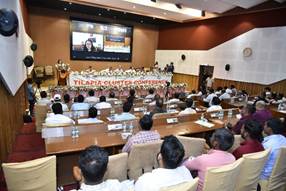
Dr. Abhilaksh Likhi, Secretary, Department of Fisheries, Ministry of Fisheries, Animal Husbandry and Dairying, chaired an interactive meeting in Raipur today to assess the cluster’s progress and understand challenges faced by farmers, entrepreneurs, exporters and other stakeholders.
The hybrid meeting brought together more than 1,300 fish farmers and value-chain stakeholders, along with officials, scientists, exporters, financial institutions and representatives of fisheries organisations.
India has recorded 198 lakh tonnes of fish production and seafood exports worth ₹73,890.46 crore, Dr. Likhi said, adding that nearly ₹900 crore has been invested under PMMSY in Chhattisgarh for quality seed, feed and modern aquaculture technologies. These interventions have helped the state double its fish production to nearly 10 lakh tonnes.
Dr. Likhi said the Centre’s cluster-based approach would focus on the entire value chain—from production and processing to value addition and market access. He called for closer cooperation between farmers, the state government, research institutions and exporters, along with a dedicated export roadmap for Chhattisgarh.
He also urged the Marine Products Export Development Authority (MPEDA) to expand its presence in the state and facilitate international market access and export promotion.
Focus on quality Tilapia seed
Following the meeting, Dr. Likhi visited MM Hatcheries at Mana, Raipur, to review genetic improvement initiatives and the production of high-quality Tilapia seed.
The hatchery is developing a genetically improved black-strain Tilapia aimed at improving seed quality, productivity and farm performance. It has received ₹5 crore in financial assistance under the Entrepreneurship Model of PMMSY and a ₹35 lakh Performance Grant under PM-MKSSY for employment generation and logistics support.
The hatchery supplies Tilapia seed across India and has contributed to Chhattisgarh’s Tilapia production, which is currently around 25,000 tonnes.
With strong global demand for Tilapia across Africa, Europe and Asia, the species offers considerable export potential. Chhattisgarh has already begun exporting Tilapia, with 382 tonnes shipped to the United States.
Farmers flag costs, credit and market challenges
During the interaction, farmers raised concerns over the availability of quality seed, high production costs, water charges and electricity expenses. They sought targeted subsidies, easier access to institutional credit and working capital, and training in modern farming techniques and export certification.
Stakeholders also called for stronger domestic and international market linkages, exposure programmes and international collaborations to improve competitiveness.
Dr. Surabhi Rai, Joint Secretary (Marine Fisheries), said the 34 fisheries clusters being developed nationwide would serve as growth engines for exports. She stressed the need for better last-mile infrastructure, technology adoption, including IoT, biofloc and Recirculating Aquaculture Systems (RAS), and improved credit absorption.
Dr. J.K. Jena, Deputy Director General (Fisheries Science), ICAR, described Chhattisgarh as having strong potential to emerge as a leading Tilapia hub and quality seed production centre. He stressed the importance of biosecurity and quality seed for sustainable aquaculture.
Stakeholders also sought a Common Facility Centre (CFC) for processing and value addition, particularly to benefit small farmers. Better farm-gate prices, waste utilisation and circular-economy practices were identified as key areas for strengthening the value chain.
Dr. Bijay Kumar Behera, Chief Executive of the National Fisheries Development Board, presented the next five-year plan for the Tilapia cluster, outlining expectations from stakeholders across the value chain.