Agricultural Universities Chart Roadmap for Viksit Bharat@2047

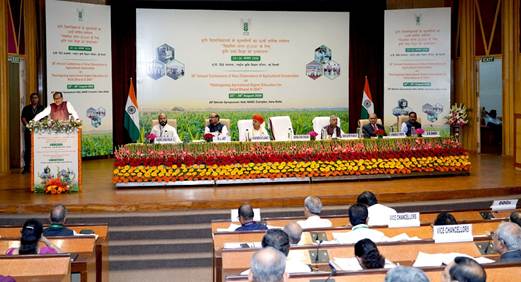
New Delhi, August 25, 2026: The 36th Annual Conference of Vice Chancellors of Agricultural Universities was inaugurated today in New Delhi by Shri Shivraj Singh Chouhan, Union Minister for Agriculture & Farmers’ Welfare and Rural Development. Organised on the theme “Reimagining Agricultural Higher Education for ViksitBharat@2047,” the two-day Conference, (25–26 August 2026), brings together Vice Chancellors of Agricultural Universities, senior officials of DARE and ICAR, Deputy Directors General, Additional Directors General and senior scientists to deliberate on reforms and priorities for a future-ready agricultural education system.
The inaugural session was attended by Shri Bhagirath Choudhary and Shri Ram Nath Thakur, Union Ministers of State for Agriculture & Farmers’ Welfare, and Dr M. L. Jat, Secretary, DARE & Director General, ICAR, along with senior officials and dignitaries.
Addressing the Conference, Shri Shivraj Singh Chouhan said the success of agricultural education should be assessed not merely by the number of degrees awarded, but by the knowledge and skills generated and the tangible impact on farmers’ lives. He called for practical, technology-driven and farmer-centric education and stronger collaboration among agricultural universities, ICAR, KVKs, FPOs, industry and farmers to translate research from laboratories into field-level solutions.
He urged universities to set clear goals, prepare actionable roadmaps and measure outcomes so that deliberations translate into concrete decisions and contribute to a modern, resilient and prosperous agricultural sector.
Shri Bhagirath Choudhary emphasised that a developed India requires a strong agriculture sector and empowered farmers. Recalling India’s journey from food scarcity to self-sufficiency, he highlighted the contribution of farmers, scientists, teachers and institutions, and called for agriculture to become more technology-driven, innovative and future-ready. He also stressed the need to attract youth through opportunities in modern technologies, research, entrepreneurship and agribusiness.
Shri Ram Nath Thakur underscored the importance of modernising agricultural education, promoting innovation and equipping youth with skills to address emerging challenges. He called for stronger links between education, research and farmers’ needs, along with greater emphasis on entrepreneurship, sustainable agriculture and practical field-level solutions.
Dr M. L. Jat emphasised the need to transform agricultural higher education from traditional models into a future-ready, skill-driven and innovation-led ecosystem. He highlighted industry–academia partnerships, demand-driven research, robust accreditation and data-driven decision-making as key priorities. He stressed that education, research and extension must work together to translate scientific knowledge into tangible benefits for farmers.
The Conference is structured into five sessions covering 14 agenda items, focusing on student-centric reforms, higher education, faculty development, institutional strengthening, quality enhancement, academic reforms, research, innovation and institutional excellence.
Key deliberations included admission systems, research fellowships, ICAR-AIQ counselling, Ph.D. counselling in Veterinary Sciences and measures to make agricultural education more accessible and inclusive. Discussions also covered accreditation, quality assurance, financial management, performance-based funding, industry–academia linkages, internships and apprenticeships, curriculum revision, and dual, twinning and joint degree programmes.
Faculty development and institutional strengthening emerged as other major areas, with discussions on degree equivalency, training needs, expert mapping and the proposed induction of Professors of Practice to bring professional expertise into agricultural universities.
The Conference also emphasised the development of an agricultural education data ecosystem for evidence-based planning and decision-making, strengthening Rural Agricultural Work Experience (RAWE), and promoting holistic student development through initiatives such as Agriunifest and Agrisports2026.
Deliberations on research and innovation focused on uniform implementation of the UGC Ph.D. Regulations, 2016, promotion of Technology Readiness Level (TRL) among State Agricultural Universities, and alignment of research with national priorities. NIRF parameters for Agriculture and Allied sectors were also discussed.
The deliberations collectively highlighted the need for Agricultural Universities to become dynamic, technology-enabled and outcome-oriented institutions integrating education, research, innovation, industry and rural engagement. Stronger partnerships, quality assurance, data-driven governance and farmer-centric research were identified as critical to building globally competitive agricultural institutions.
Earlier, Dr Yashpal Malik, Deputy Director General (Agricultural Education), ICAR, delivered the welcome and context-setting address. The inaugural session also included a review of the Action Taken Report and progress on decisions of the previous Vice Chancellors’ Conference.