Cooperation Secretary Dr Ashish Kumar Bhutani Releases Book on Cooperative Management

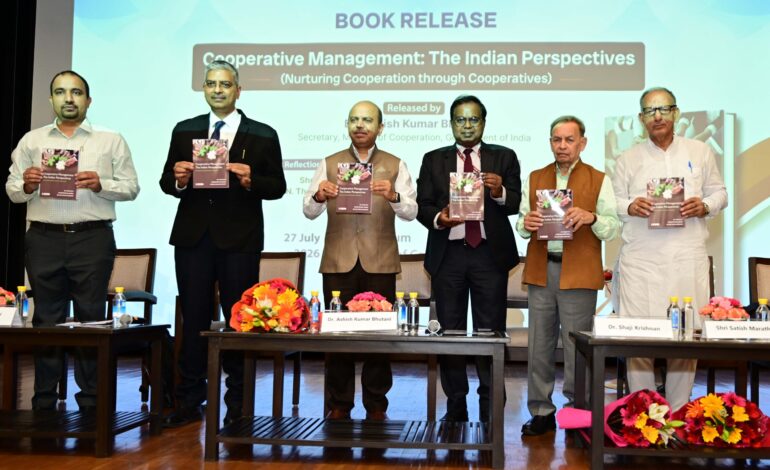
New Delhi, 27 July: Dr. Ashish Kumar Bhutani, Secretary, Ministry of Cooperation, Government of India, today released the book “Cooperative Management: The Indian Perspectives (Nurturing Cooperation through Cooperatives)”, a comprehensive publication that seeks to strengthen cooperative education, management, and capacity building in line with the vision of “Sahkar Se Samriddhi” and Viksit Bharat @2047.
Authored by Dr. K. K. Tripathy, Joint Secretary, Economic Advisory Council to the Prime Minister (EAC-PM); Dr. Harekrishna Misra, former Professor, Institute of Rural Management Anand (IRMA); and Dr. Sagar Kisan Wadkar, cooperative policy analyst and academician, the book presents an integrated perspective on cooperative management by combining cooperative principles with contemporary management practices, governance reforms, digital transformation, and institutional innovations.
The programme also featured reflections on the book by distinguished leaders from the cooperative and financial sectors. Dr. Shaji K. V., Chairman, NABARD, highlighted the transformative role of Primary Agricultural Credit Societies (PACS) and Multi-purpose PACS (MPACS) as the foundation of grassroots rural transformation, emphasising the need to strengthen them as vibrant, member-centric institutions capable of delivering multiple economic services.
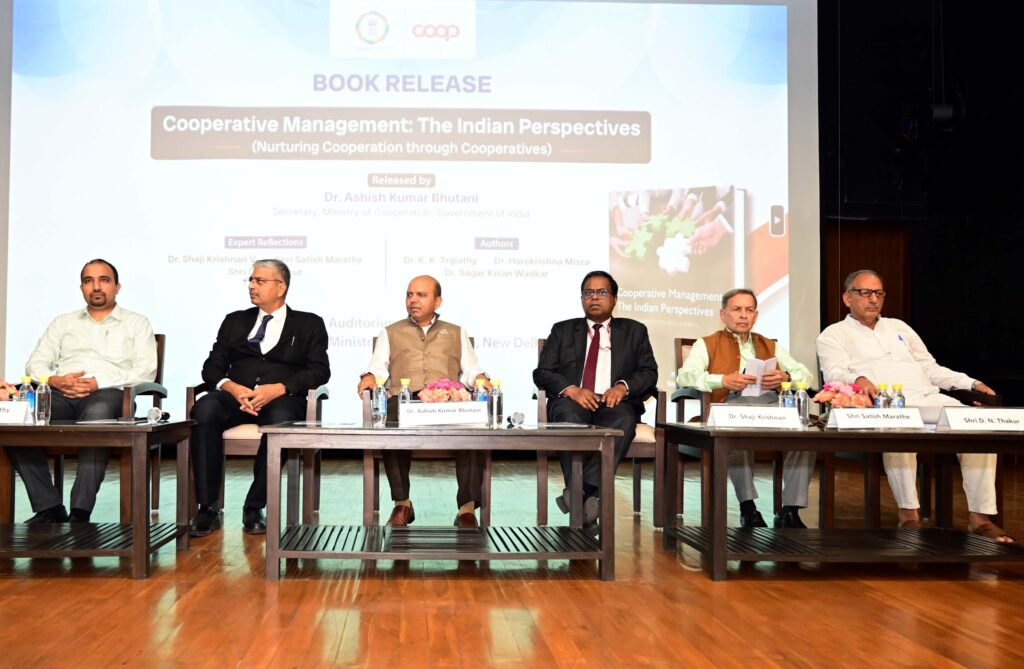
Shri Satish Marathe, Director, Central Board of the Reserve Bank of India and Director, NABARD, underlined the pivotal role of cooperative banking in deepening financial inclusion, enhancing financial resilience, and expanding access to affordable credit for millions of members. He stressed that professionally managed and well-governed cooperative financial institutions will remain indispensable for achieving inclusive economic development.
Shri D. N. Thakur, former Deputy Managing Director, National Cooperative Development Corporation (NCDC), and a noted cooperative practitioner, emphasised the growing importance of technology in transforming cooperatives into competitive business enterprises. He highlighted the need for digitalisation, data-driven decision-making, efficient value chains, and technology-enabled value addition to improve productivity, market access, and business competitiveness across cooperative sectors.
Delivering the Chairperson’s address, Dr. Ashish Kumar Bhutani, Secretary, Ministry of Cooperation, underscored that India’s cooperative movement is entering a new phase of transformation under the vision of “Sahkar Se Samriddhi.” He emphasised that achieving the goal of Viksit Bharat @2047 would require professionally managed, transparent, accountable, technology-enabled, and member-driven cooperatives. He noted that strengthening cooperative education, leadership development, and management capacity would be critical to building globally competitive cooperative enterprises capable of contributing significantly to India’s economic growth and inclusive development.
Spread across nine thematic chapters, the book covers the evolution of the cooperative movement, policy and legal frameworks, member-centric governance, cooperative banking, human resource management, digital transformation, and the emerging role of Multi-purpose PACS. Designed with learning objectives and reflective questions, it is expected to become a valuable resource for students, researchers, policymakers, practitioners, cooperative training institutions, and the Tribhuvan Cooperative University.
The release of the book marks an important milestone in enriching the intellectual foundations of India’s cooperative movement and reinforcing the national commitment to building a vibrant, modern, and future-ready cooperative ecosystem.